Dazzle Johnson's Continuous Dynamic Flexible Job Shop Scheduling Research Published in IEEE Transactions on Automation Science and Engineering
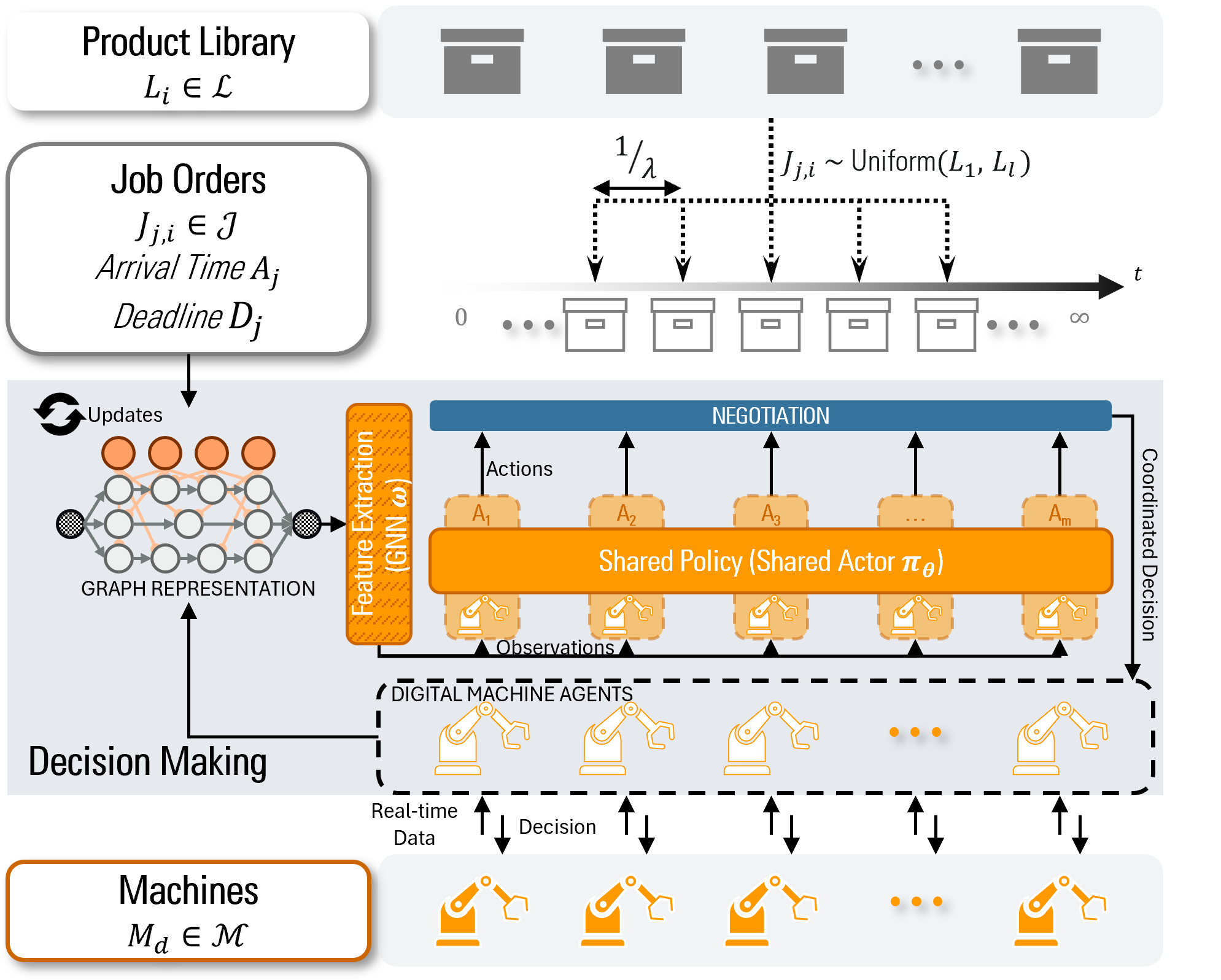
We are delighted to announce that Dazzle Johnson's PhD research has been accepted for publication in *IEEE Transactions on Automation Science and Engineering*. The paper, co-authored with Gang Chen (Victoria University of Wellington) and Yuqian Lu, introduces the MACD (Multi-Agent Continuous Decision-Making) system for solving the Continuous Dynamic Flexible Job Shop Scheduling Problem (C-DFJSP).
About the Research
Modern manufacturing — driven by mass personalisation — demands scheduling systems that adapt in real time to continuous job arrivals, diverse products, and evolving factory configurations. Traditional methods struggle with this level of dynamism. MACD addresses these challenges head-on with a novel multi-agent architecture.
Key Contributions
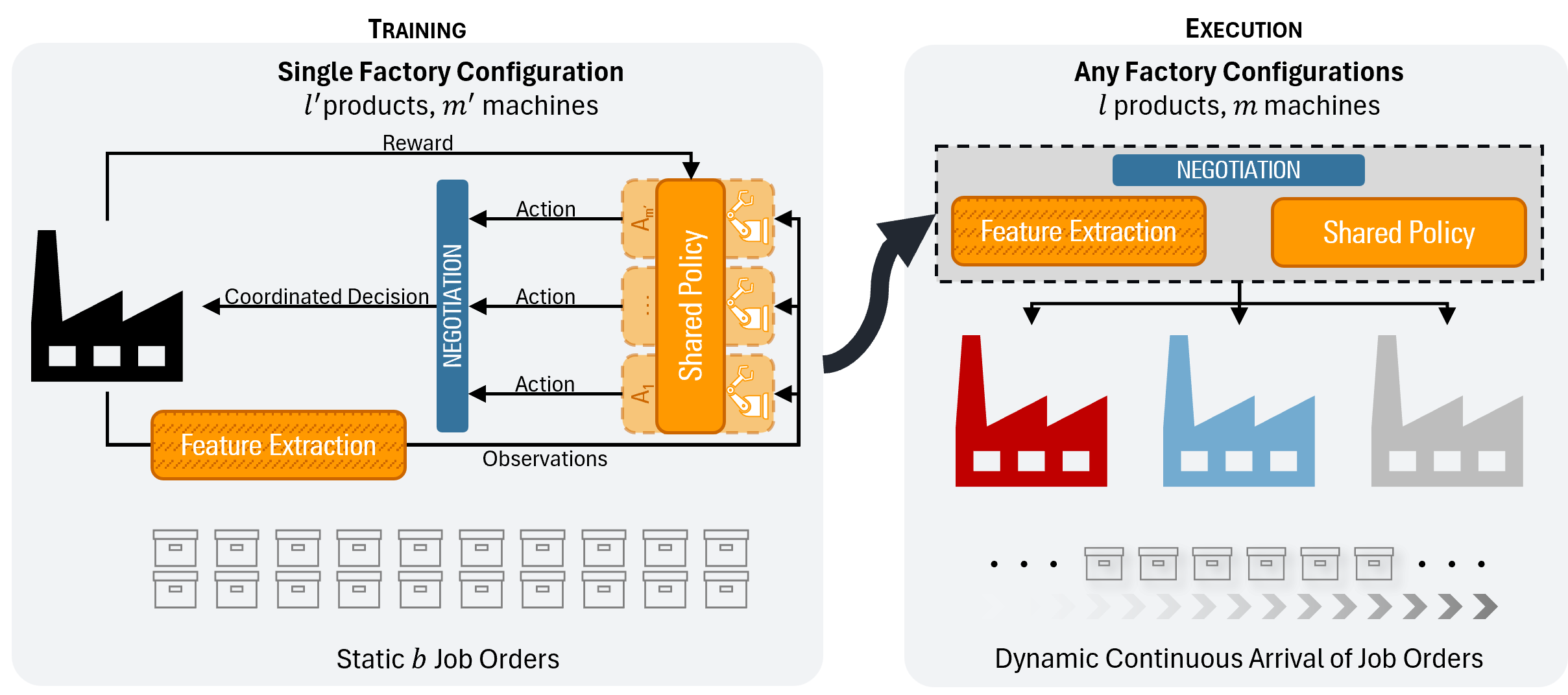
- Generalisable scheduling framework: A single MACD model trained on a small static environment can be directly deployed in large-scale dynamic factories with no retraining required.
- Operation-centric graph representation: Only operation nodes are embedded; machine-level constraints are incorporated via attention-based aggregation, significantly improving scalability.
- Rule-guided negotiation: A lightweight hybrid strategy combining Shortest Processing Time (SPT) and Least Loaded Machine (LLM) heuristics resolves rare conflicts among machine agents without centralised control.
- Factory-invariant features: Graph Neural Networks (GNNs) extract features that generalise across factories with varying machine counts, flexibility levels, and product libraries.
Results
Extensive experiments on the Brandimarte and Hurink benchmark datasets — scaling to 30 products, 15 machines, and over 1,000 job orders per simulation — demonstrate MACD's superior performance over heuristic methods and the prior state-of-the-art. Each scheduling decision averages just 54 ms on standard hardware, confirming real-time suitability for industrial deployment.
Relevance to New Zealand Manufacturing
This research holds particular significance for New Zealand's manufacturing sector, where small and medium enterprises (SMEs) form the backbone of the economy. Unlike large-scale factories with predictable, structured workflows, NZ SMEs frequently operate in highly dynamic, unstructured production environments — handling diverse custom orders, shifting priorities, and limited machine resources simultaneously. Traditional scheduling tools, designed for stable and repetitive production, fall short in these conditions. MACD's ability to learn a single scheduling policy that generalises across different factory sizes and product mixes — without retraining — makes it especially well-suited for the varied and fast-changing demands faced by NZ manufacturers. By reducing tardiness and preventing job backlogs in real time, this technology has the potential to meaningfully improve productivity, on-time delivery, and operational resilience for local industry.
Congratulations to Dazzle on this excellent achievement, which marks the culmination of her PhD at the University of Auckland.