AI is becoming a routine part of industrial work. It can support decisions, automate routine activities and assist people. But whether AI adoption succeeds depends on more than what the technology can do. It also depends on how people experience and work with it.
This white paper presents a practical framework for designing human-AI collaboration. It considers the human, the AI system, the task, the organisation and the wider society. It explains what effective collaboration looks like, which conditions influence it, which requirements must be met, and which design decisions organisations should consider.
The report also includes a use case: a human-AI collaborative assembly system with a cobot. The use case shows how design requirements can be translated into specific collaboration features and evaluated in a participant study.
Key findings
Top takeaways
Seven messages from the report.
01
The core message
Effective human-AI collaboration must be designed, not assumed.
AI can improve productivity, creativity and performance, but it can also create distrust, anxiety, job insecurity, role ambiguity and loss of autonomy. Favourable outcomes depend on deliberate design, not technical capability alone.
How to think about it
Collaboration is a system, success is broader than productivity, and context decides the design.
02
Human-AI collaboration is a socio-technical system.
Collaboration depends on the interaction between the human, AI system, task, organisation and wider societal environment. A change in one domain can affect the others.
03
Success is more than productivity.
Effective human-AI collaboration should support positive human experiences, strong collaboration and task performance, and sustainable organisational and societal outcomes.
04
Context determines the design.
Human capabilities, AI reliability, task demands, organisational support and societal expectations shape which requirements and design decisions matter most.
What to design for
People's needs and teamwork, with responsibility built in from the start.
05
Human needs and teamwork requirements are central.
Human-AI collaboration should support autonomy, competence, relatedness, safety and privacy, while enabling shared goals, coordination, communication, adaptability, calibrated trust and appropriate human control.
06
Responsible deployment starts at the design stage.
Fairness, transparency, safety, privacy, security, accountability, training and ongoing support should be built in from the outset rather than added after deployment.
Keeping it working
Design does not end at deployment.
07
Collaboration should be continuously evaluated and refined.
As people gain experience and technologies or tasks change, requirements may change too. The framework treats design and evaluation as an iterative process.
The same AI can be seen as an assistant or as a threat, depending on whether users trust it, have prior experience, and are supported through the change. Management support and implementation strategy decide whether AI is accepted or resisted. At the technology level, reliability, transparency, controllability and safety shape how AI is perceived and used.
A technically capable system can therefore still fail in practice. This is why the report treats human-AI collaboration as a socio-technical design challenge.
It is also a national question for New Zealand. In 2024 Cabinet agreed a national strategic approach to AI. It identified mistrust of AI, together with low uptake across the economy, as key barriers. Trust must be earned through how AI is introduced and experienced, in a single workplace or across a national economy. How human-AI collaboration is designed is therefore not only an organisational concern.
Effective human-AI collaboration must be designed, not assumed.
Chapter 2
A framework for designing human-AI collaboration
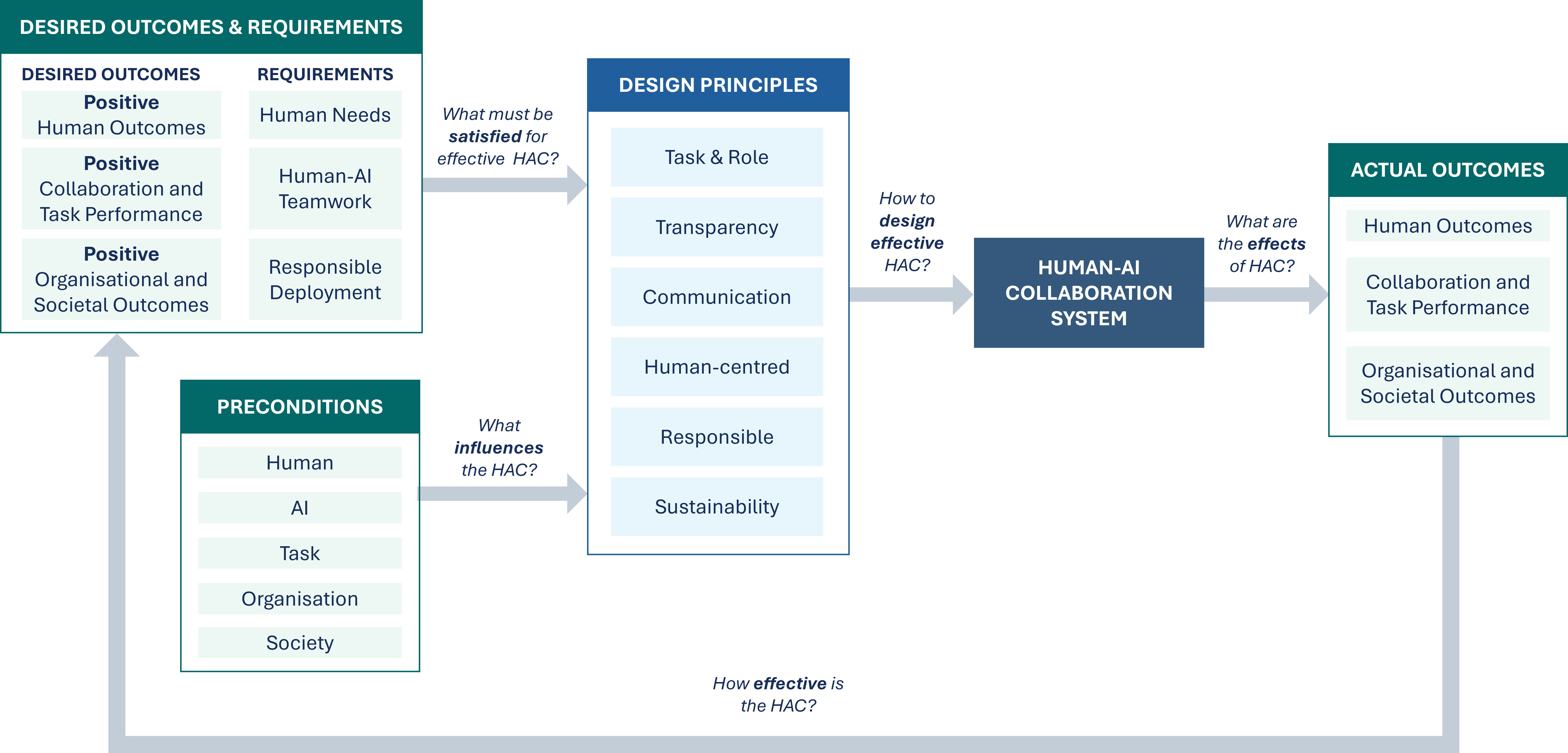
The framework starts from two inputs: the desired outcomes and requirements, and the preconditions of the human, AI, task, organisation and society. Together they inform the design principles. Once deployed, the system produces actual outcomes, which are compared with the desired ones to close the loop.
Figure 1 · Human-AI collaboration as a socio-technical system. Source: Working with AI white paper. Click or tap the image to enlarge.
2.1 Outputs: what does effective collaboration look like?
A system is not effective just because task performance improves. Effectiveness is assessed at three levels.
Level 1
Human outcomes
Emotional and psychological responses
Professional experience and identity
Physical and cognitive well-being
Trust and acceptance (calibrated, not blind)
Level 2
Collaboration and task performance
Collaboration quality: goal alignment, shared understanding, coordination, appropriate control
Productivity, ROI, workforce capability and retention, sustainable adoption
Public trust, labour-market effects, privacy, regulatory accountability
2.2 Requirements: what must be satisfied?
Achieving the desired outcomes is not automatic. Three layers of requirements must be met.
Layer 1
Human needs
Professional: job security, learning and growth, meaningful work
Psychological: autonomy, competence, relatedness
Personal well-being: safety and privacy
Layer 2
Human-AI teamwork
Shared goalsShared understandingCoordinationCommunicationAdaptabilityCalibrated trustAppropriate control
Drawn from the “Big Five” model of teamwork. Human-AI teams differ in one respect: the human needs a more authoritative role over the AI, for safety.
Layer 3
Responsible deployment
Aligned with the OECD AI Principles, which New Zealand's Cabinet strategy also adopts:
Inclusive growth and well-being
Human rights and fairness, including privacy
Transparency and explainability
Robustness, security and safety
Accountability
2.3 Preconditions: what influences the collaboration?
The aim is not to decide whether an organisation is “ready” or “not ready”. It is to find where strengths, constraints and risks lie, so the design can respond to them.
Human
What the human brings into the collaboration
AI and technical literacy, prior experience, confidence, motivation, adaptability.
Assess with: skills and literacy audit, worker survey
AI
The technical characteristics of the system
Reliability and accuracy, robustness, transparency and explainability, usability, safety and privacy protection.
Assess with: system validation and testing, edge-case testing, safety and privacy audit
Task
The nature of the work
Complexity, physical and cognitive demands, observability, time pressure, uncertainty and risk.
The external environment the organisation operates within
Legislation, standards, ethics, labour policies, public expectations and trust, technological maturity.
Assess with: regulatory and compliance review, stakeholder consultation, industry standards review
Chapter 3
Six design principles
The principles turn the framework into action. Each is a set of questions that connect design choices back to the requirements. They are not a fixed checklist: their relative weight depends on the use case. A safety-critical application may need more human control and transparency, while an experienced workforce may need less onboarding and more personalisation.
01
Task & role design
What role does the AI play: assistant or autonomous agent?
Is task allocation fixed or dynamic?
How much autonomy and control does the human keep?
02
Transparency design
What does the human know about what the AI observes, decides and does?
What level of explanation is given, by default or on request?
03
Communication design
Which channel is used: voice, screen or gesture?
How does the human give commands, confirmations, overrides and feedback?
04
Human-centred design
How is trust established early on?
What training or onboarding is provided?
Can the human personalise the system and suggest changes?
05
Responsible design
What safety mechanisms exist?
Can the human override or stop the AI at any time?
How is data protected, and who is accountable?
06
Sustainability design
What ongoing training and support is provided?
Who maintains and updates the system?
How does it fit existing workflows, tools and processes?
Applying the framework: a five-step iterative process
Treat the steps as a loop, not a one-off sequence. As users gain experience, tasks change or AI capabilities evolve, the preconditions and requirements shift, so the framework can be revisited.
Understand the use case
Identify the preconditions across human, AI, task, organisation and society.
Identify desired outcomes and requirements
Decide which needs, teamwork and deployment requirements matter most.
Apply the design principles
Make context-specific design decisions.
Implement the design decisions
Translate them into task allocation, interfaces, safety mechanisms and support.
Evaluate the outcomes
Assess against the outcomes defined earlier, then refine and repeat.
Chapter 4
Use case: a human-AI collaborative assembly system with cobots
To show how the framework works in practice, the team designed and evaluated a collaborative assembly system. The task was a sequential assembly of the BV704 ball valve, manufactured by supporting partner Oasis Engineering. The worker assembled the valve, while a Franka Research 3 collaborative robot acted as an assistant and supplied the right tool at each stage.
30
participants, each completing six assembly runs
22 / 30
had no prior experience with collaborative robots
77%
changed their configuration at least once during the study
1
deliberate robot error in Run 5: the wrong tool was handed over
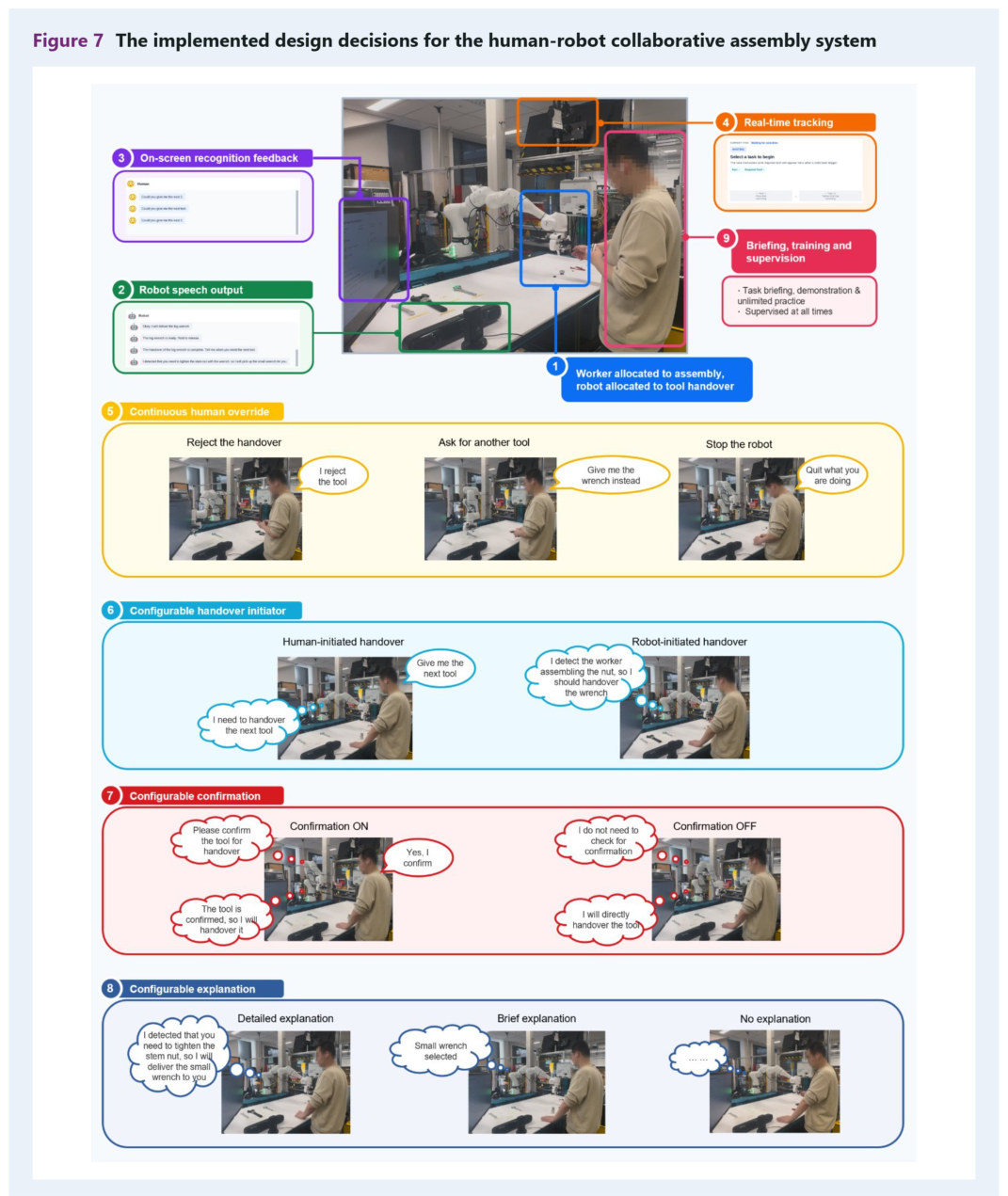
The system combined an RGB-D camera with an action-recognition model to detect the current assembly step, plus voice recognition, audio output and a monitor for two-way interaction. The design decisions were turned into configurable features: who initiates the tool handover (worker by voice, or robot automatically), whether the robot asks for confirmation, and how much it explains (detailed, brief or none). The worker could override or stop the robot at any time, and researchers supervised every session.
In Runs 1 to 3, participants were assigned different configuration combinations. In Runs 4 to 6, they chose their own.
Figure 7 · The implemented design decisions for the human-robot collaborative assembly system. Source: Working with AI white paper. Click or tap the image to enlarge.
The study illustrates human and task-level outcomes. Organisational and societal outcomes are beyond the scope of a single laboratory study.
Findings
What the study found
Results from 30 participants across six runs each. Survey scores are on a 1 to 7 scale.
Trust responded to what the robot actually did
Mean self-reported trust and reliance (1–7), Runs 1–6. Axis shows 4 to 6.
TrustReliance
Run 1
Run 2
Run 3
Run 4
Run 5
Run 6
Trust
5.47
5.40
5.37
5.87
4.60
5.83
Reliance
4.77
5.03
5.43
5.50
5.20
5.77
One visible error was enough for trust to drop, and one run of correct behaviour was enough to restore it. This is what appropriate trust should look like: workers adjusted it to the robot's actual performance. Reliance rose steadily from 4.77 to 5.77 as participants became familiar with the robot, because the task was built around the robot delivering every tool.
The valve was assembled faster with experience
Mean completion time per run, in seconds.
Run 1174
Run 2150
Run 3124
Run 4123
Run 5 · error157
Run 6118
Completion time fell from 174 s to 123 s by Run 4, rose to 157 s when participants handled the wrong tool, and reached its lowest, 118 s, in Run 6. Mental demand also fell across runs, from 3.13 in Run 1 to 1.87 in Run 6.
People need enough control, not maximum control
Mean perceived control (1–7).
Same 23 participants, runs 1–3
Human-led5.58
Robot-led4.37
Control under robot-led handover
Assigned (runs 1–3)4.33
Chosen (runs 4–6)4.99
These participants rated human-led handover as giving more control, yet 23 of 30 chose robot-led. Being able to choose the configuration also raised perceived control. Once a baseline of control is met, people will trade some for efficiency.
Preferences converged, but individuals kept adjusting
Share of 30 participants, by their final preferred configuration.
77%
preferred robot-led initiation
87%
preferred confirmation turned off
29 of 30
preferred brief or no explanation
Handover initiator
Robot-led77%
Human-led23%
Confirmation
Off87%
On13%
Explanation
None50%
Brief47%
Detailed3%
Changes across self-selected runs 4–6
Same all 3 runs23%
Changed once40%
Changed every run37%
Overall preferences settled quickly, but only 23% of participants kept the same configuration across all three self-selected runs. The system supported every change, because participants could reconfigure before each run.
What the use case demonstrates
The same feature can create both benefits and costs, which is why deliberate design matters.
Robot-led initiation
Improved efficiency
Reduced perceived control
Confirmation
Supported oversight
Added interaction burden
Detailed explanation
More information
Slower performance
There is no single universally optimal human-AI collaboration configuration.
Chapter 5
Implications for practice
Organisations should treat human-AI collaboration as a socio-technical design challenge, not simply a technology implementation exercise.
Understand the use case first by assessing the human, AI, task, organisational and societal preconditions that shape the collaboration.
Prioritise the most important requirements for the context: worker needs, teamwork quality, safety, transparency, trust and human control.
Make design decisions deliberately around task allocation, AI autonomy, communication, explanation, worker control, training, privacy, accountability and ongoing support.
Allow the collaboration to adapt over time. Workers refined their preferences through repeated use, and pointed to efficiency, reliability and personalisation as areas to improve.
Evaluate more than productivity alone. Effective human-AI collaboration should also support positive worker experiences, strong collaboration and sustainable organisational and societal outcomes.
Behind the report
Staff and researchers
Yuqian Lu
Lead Researcher
Department of Mechanical and Mechatronics Engineering, The University of Auckland
Lixin Jiang
Researcher
School of Psychology, The University of Auckland
Andrew McDaid
Researcher
Department of Mechanical and Mechatronics Engineering, The University of Auckland
Regina Lee
Graduate Researcher
Department of Mechanical and Mechatronics Engineering, The University of Auckland
Rui Zhou
Graduate Researcher
Department of Mechanical and Mechatronics Engineering, The University of Auckland
Amy Lawrence
Graduate Researcher
School of Psychology, The University of Auckland
Supporting partner
Financial acknowledgement: This report is proudly brought to life with support from the Transdisciplinary Ideation Fund at The University of Auckland.
Prepared by: Industrial Artificial Intelligence Group, The University of Auckland.
How to cite: Yuqian Lu, Regina Lee, Rui Zhou, Lixin Jiang, Andrew McDaid, Amy Lawrence, “Working with AI: A Design Framework for Human-AI Collaboration,” Industrial Artificial Intelligence Group, The University of Auckland, September 2026. https://doi.org/10.48550/arXiv.2609.31793
Licence: The Working with AI: A Design Framework for Human-AI Collaboration report by The University of Auckland is licensed under CC BY-NC-ND (Creative Commons Attribution-NonCommercial-NoDerivatives).
Read the full report
44 pages, with the complete framework tables, the detailed use case, references and the post-task survey.